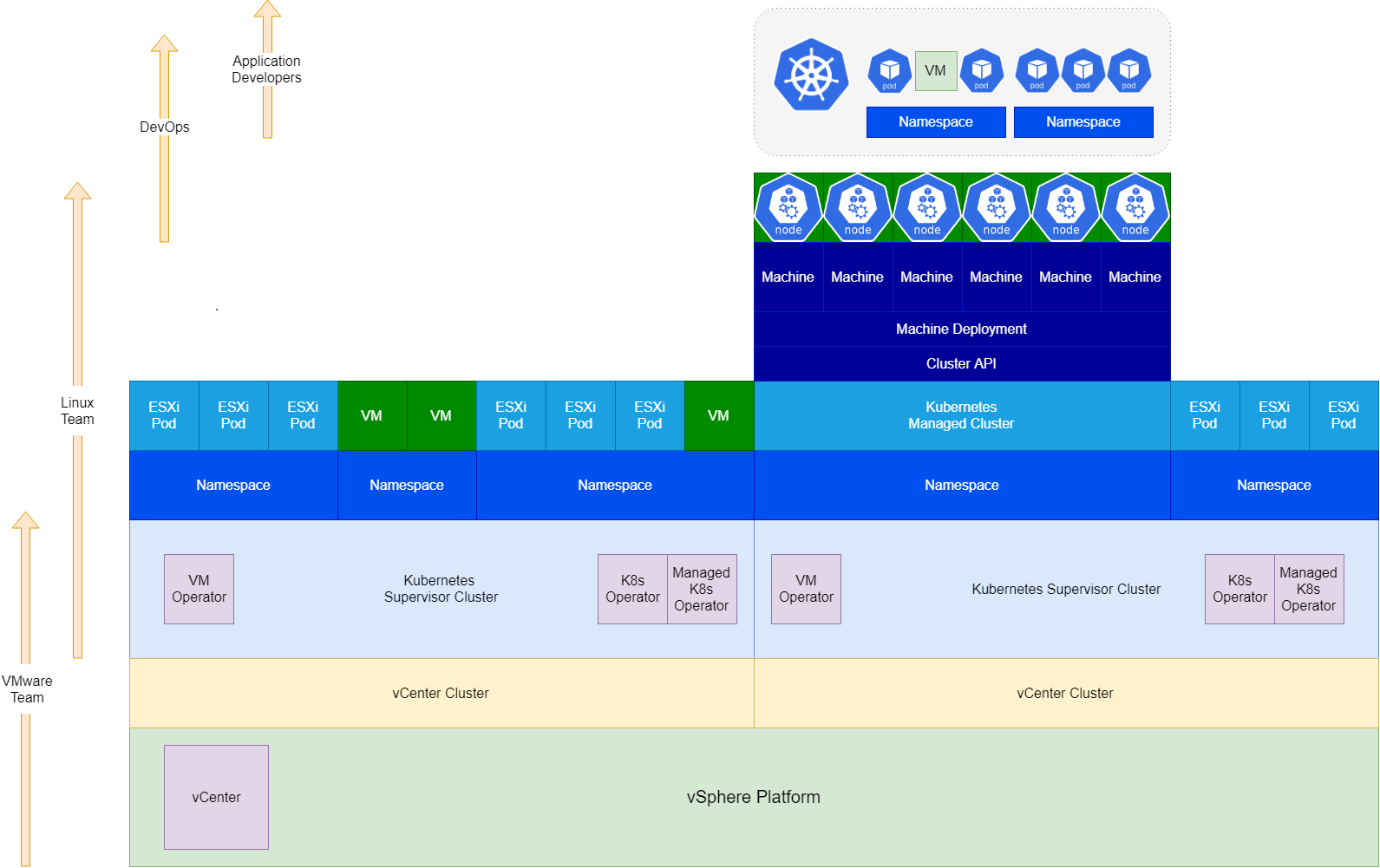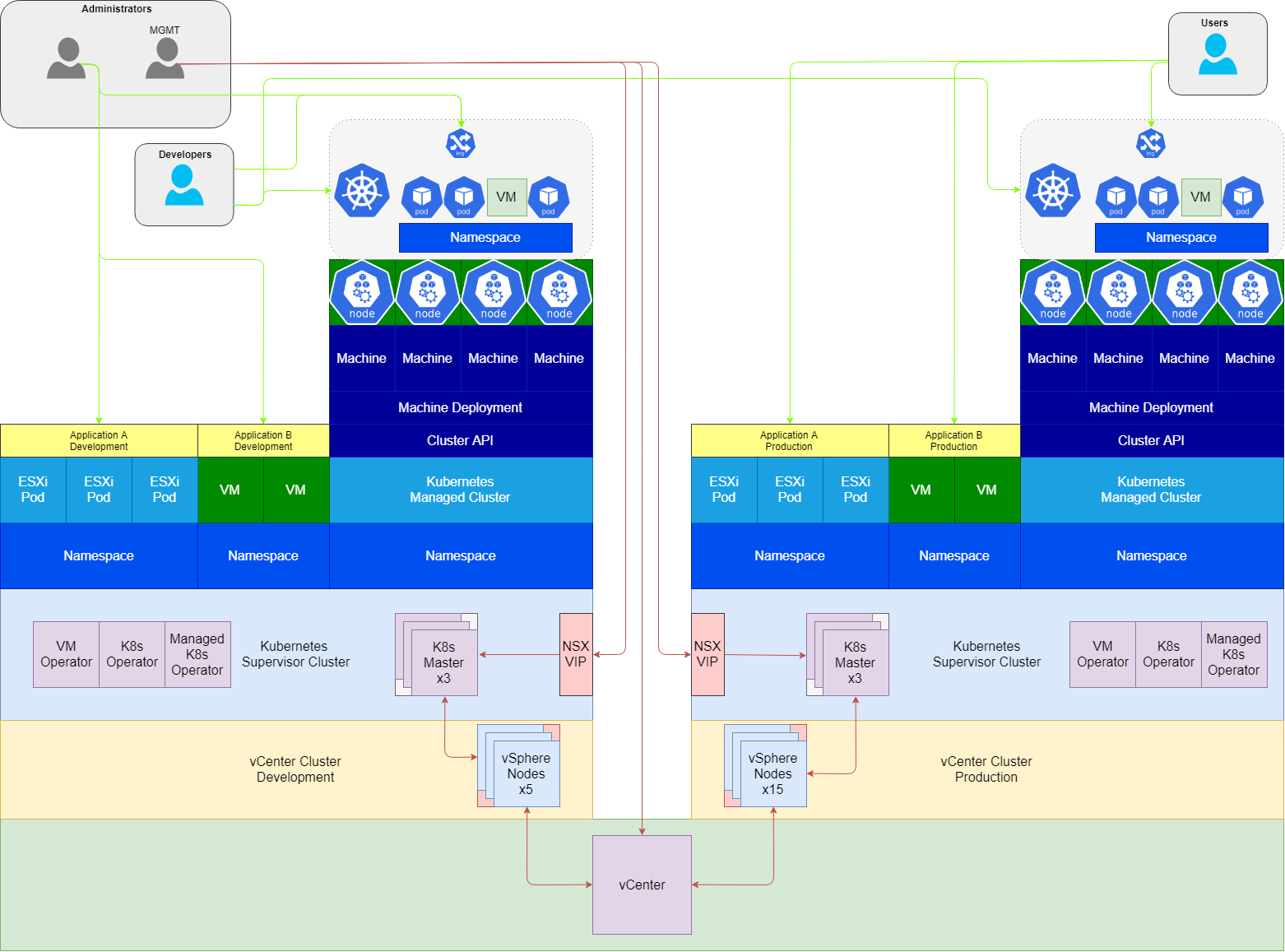
VMware Project Pacific
The current status of Kubernetes with VMware Project Pacific.
Background
Kubernetes service offering with Project Pacific.
Requirements
Project Team
Meeting business requirements as quickly as possible.
Platform Team
Building a platform to meet current and future requirements.
Sustainable
Follow Best Practices
Observable
Flexible
Secure
Cloud-like
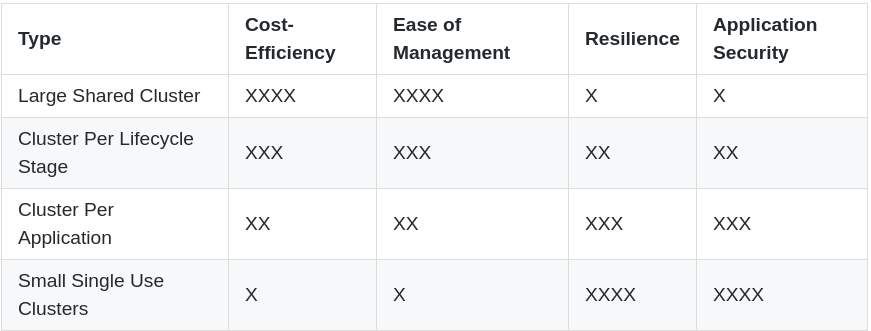
Cluster Architecture
What to do?
- Run many workloads on large clusters
- Run few workloads on many clusters
Large Shared Cluster (Pros)
- Efficient Resource Usage
- Cheaper
- Efficient Administration
Large Shared Cluster (Cons)
- Blast Radius
- No Hard Security Isolation
- No Hard Multi-Tenancy
- The Many user problem
- Clusters are finite
Cluster Per Lifecycle Stage (Pros)
- Isolation of the Production environment
- Clusters can be customised per environment
- Lock down access to the Production environment
Cluster Per Lifecycle Stage (Cons)
- Lack of isolation between applications
- Application requirements are not localised
Cluster Per Application (Pros)
- Clusters can be customized per application
Cluster Per Application (Cons)
- Different Lifecycles in the same Cluster
Small, Single User Clusters (Pros)
- Reduced Blast Radius
- Isolation
- Few Users
- Great for experimentation
Small, Single User Clusters (Cons)
- Inefficient resource usage
- Expensive
- Complex Administration
PaaS Options
If I had a dollar for every available Kubernetes distribution.
OpenShift v3.x and v4.x
The Red Hat Kubernetes Platform as a Service.
RancherOS (managed with Rancher)
Lightweight OS for running Docker containers.
k3OS (managed by Rancher)
Lightweight OS for Kubernetes Nodes.
Talos OS (managed with Rancher)
Lightweight OS for Kubernetes Nodes.
VMware Project Pacific
The Evolution of the vSphere Platform.
VMware Project Pacific overview
- Architecture
- Example
- Risks and Benefits